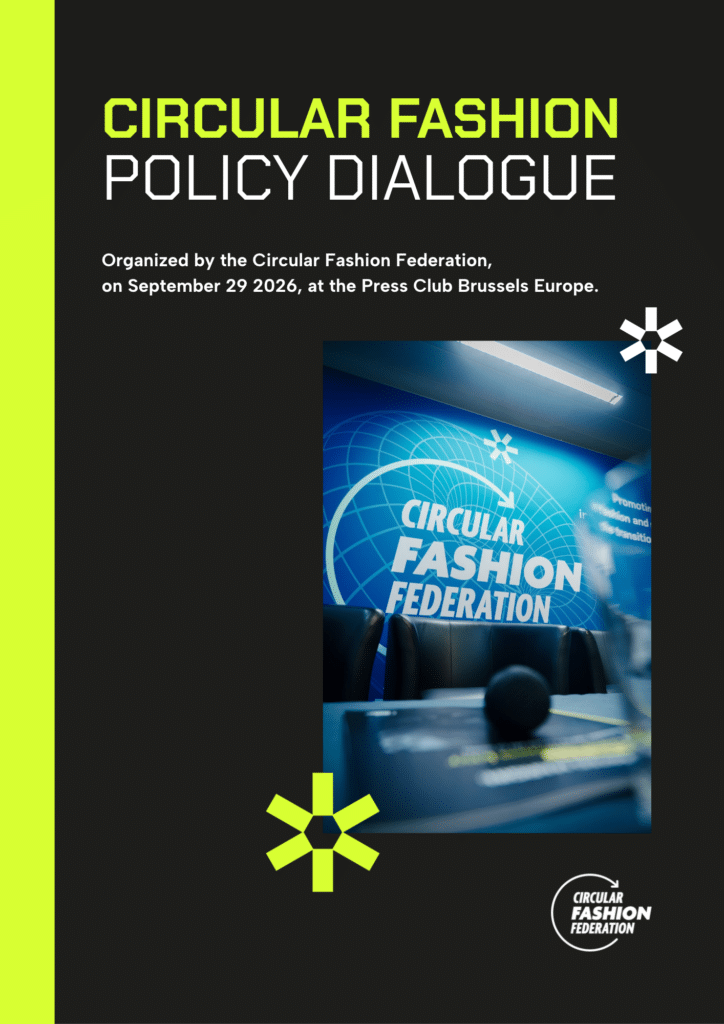
MEP Rasmus Nordqvist opened the morning by arguing that Europe’s single market is its real advantage and that textile policy now needs to move faster. COSE361 and Appinio then presented the first results of the DEX project on extrinsic durability. This led into the first panel on harmonising eco-modulation in textile EPR schemes, moderated by Stéphane Popescu (COSE361), with MEP Delara Burkhardt, Vincenzo Gente (DG ENV), Luca Campadello (Erion Textiles) and Kerli Kant Hvass (Landbell Group).
The second half turned to taxation. The Federation presented its circular VAT white paper, and Valerie Boiten (Ellen MacArthur Foundation) and Marta Inchausti Moya (Global Fashion Agenda) gave keynotes in support. Clara Cherblanc (CFF) then moderated a panel with David Boublil (DG TAXUD), Charlotte Krist (United Repair Centre), Klemen Drole (Vestiaire Collective) and Maria Åkerfeldt (H&M Group). Eric Mamer, Director-General for Environment at the European Commission, closed the event with a preview of the Circular Economy Act.
Key takeaways
The Circular Economy Act is due in mid-November. The Federation will submit its contribution to the Commission’s VAT consultation before 4 November, and any organisation can endorse it.
The Federation asks for a Reduced VAT on repair, applied by Member States now, extended to all circular services by 2028, and harmonised, transparent EPR criteria in the Circular Economy Act.