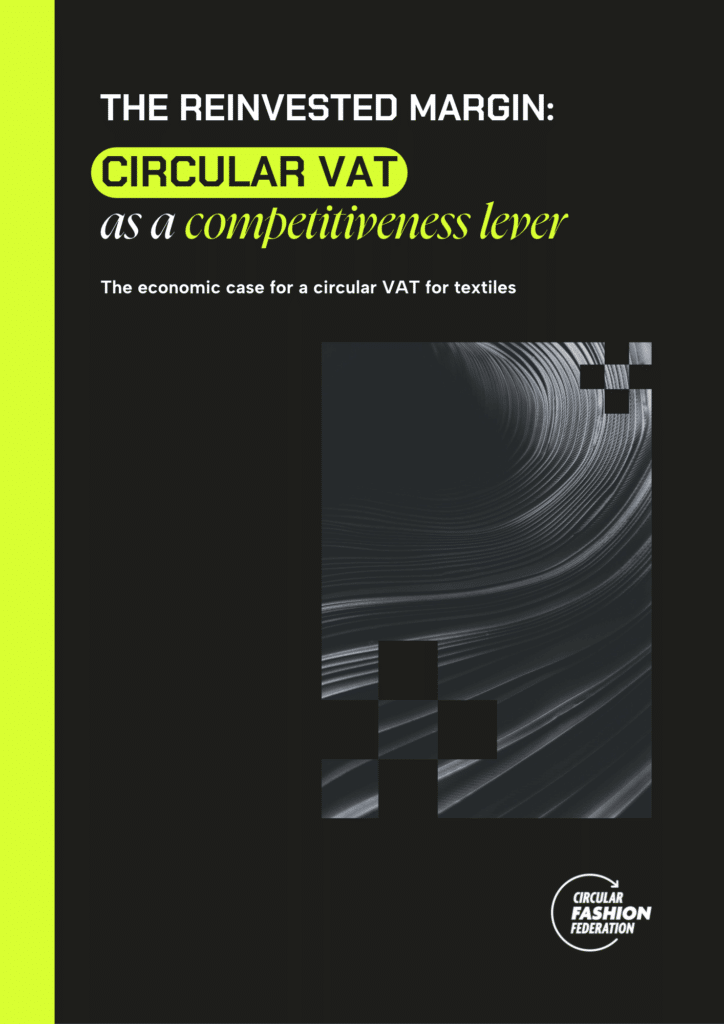
Repair, maintenance and resale keep garments in use and anchor skilled jobs in Europe. Yet in most Member States they are taxed at the standard VAT rate, up to 27%, and second-hand goods are, in effect, taxed twice. EU law has allowed a reduced rate on clothing, footwear and leather repair since 2022, but only a minority of Member States apply it.
Field evidence gathered from European repair, resale and garment-care operators shows what a circular VAT would change on the supply side:
~12% of turnover freed by moving from a 20% to a 5.5% rate
92% of that margin reinvested in the business, first in wages, equipment and hiring
15 to 30% of the measure’s cost self-financed through new jobs, the shift to durable goods and avoided waste
A circular VAT is not a subsidy but an investment in the viability of an entire sector, one that largely pays for itself.
Produced by the Circular Fashion Federation’s working group on circular VAT, coordinated by Clara Cherblanc and Maxime Delavallée with our members, the publication is endorsed by partner organisations including the Ellen MacArthur Foundation and Global Fashion Agenda.
The publication is part of a broader European momentum. In September 2026, the European Commission launched a public consultation on aligning EU VAT rules with the circular and low-emission economy, as part of the preparatory work for the Circular Economy Act. Our work contributes to this process by bringing operators’ field evidence to the debate on how VAT can support circular business models.
Next steps on circular VAT
Our working group continues; data collection is still ongoing to gather more field insights, refine the analysis and extend it to the full range of circular business models. Operators wishing to contribute their data are warmly invited to get in touch.